
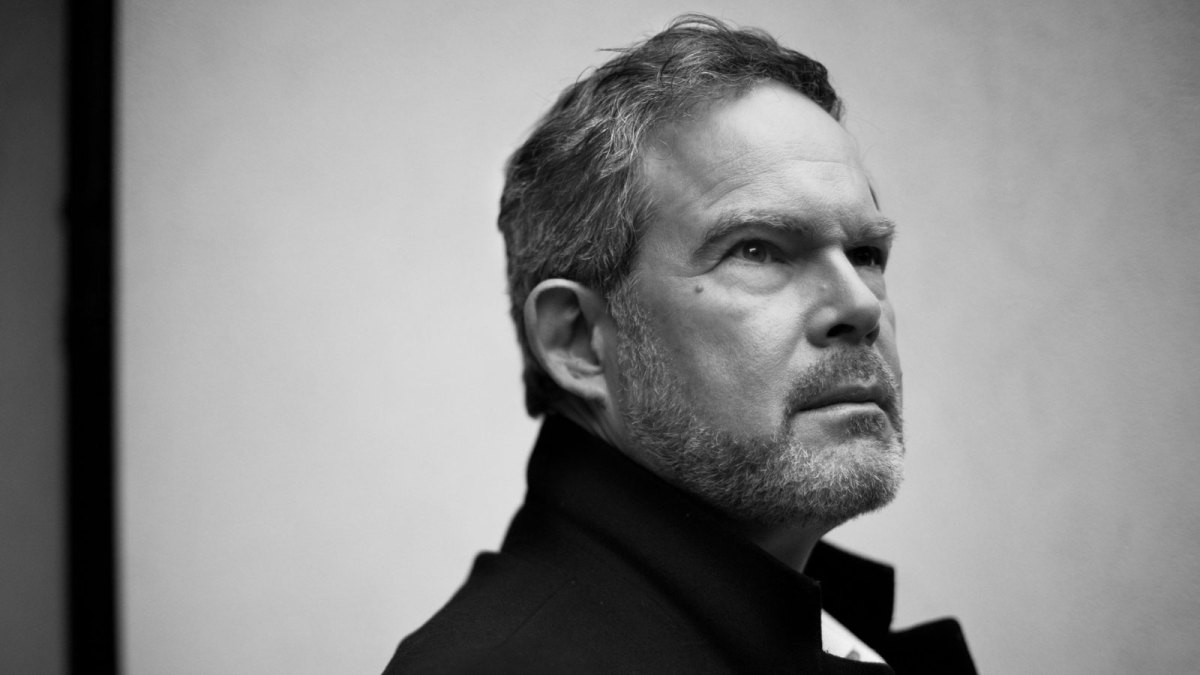
“When I finish a cycle with Broadway tunes, or what I would call The Pops, there’s a release of energy. But, for the meat and potatoes of those concerts, I’m on my own. Of course, I’m not being told what to do, so it’s hard to think, well, how did that go over?” The rich, bass-baritone voice of Gerald Finley, finely enunciated and faintly transatlantic—he doesn’t slur out pudados, but works his mouth around po-ta-toes—conveys nothing less than certainty, authority, and comfort; Finley filled my room as if he was in it, and not several thousand miles away at his home in Kent, dialling in on FaceTime
Finley was born in Montreal. Though he trained as a vocalist—first as a chorister in Ottawa, then at Cambridge, then at the UK’s National Opera Studio—he considers himself as much an actor as a singer. Wearing a black polo and flanked by a full bookcase, he spoke at length about finding the psychological hooks of his operatic characters, and on cracking the poetic connections of song cycles.
At 65, he shows no signs of thinning his schedule. In the latter half of 2025, he will perform at the Royal Opera House in Puccini’s “Tosca,” and as Don Alfonso in Mozart’s “Così fan tutte” at La Scala. On Friday, he’ll perform at the First Night of the Proms.
The day before our conversation, he had performed, as part of the Cheltenham Music Festival with pianist Isata Kanneh-Mason, in a recital of Beethoven, Grieg, Schubert, Turnage, and Ralph Vaughan Williams. I began by asking him about the latter’s “Songs of Travel.”
Unlimited access to our
