
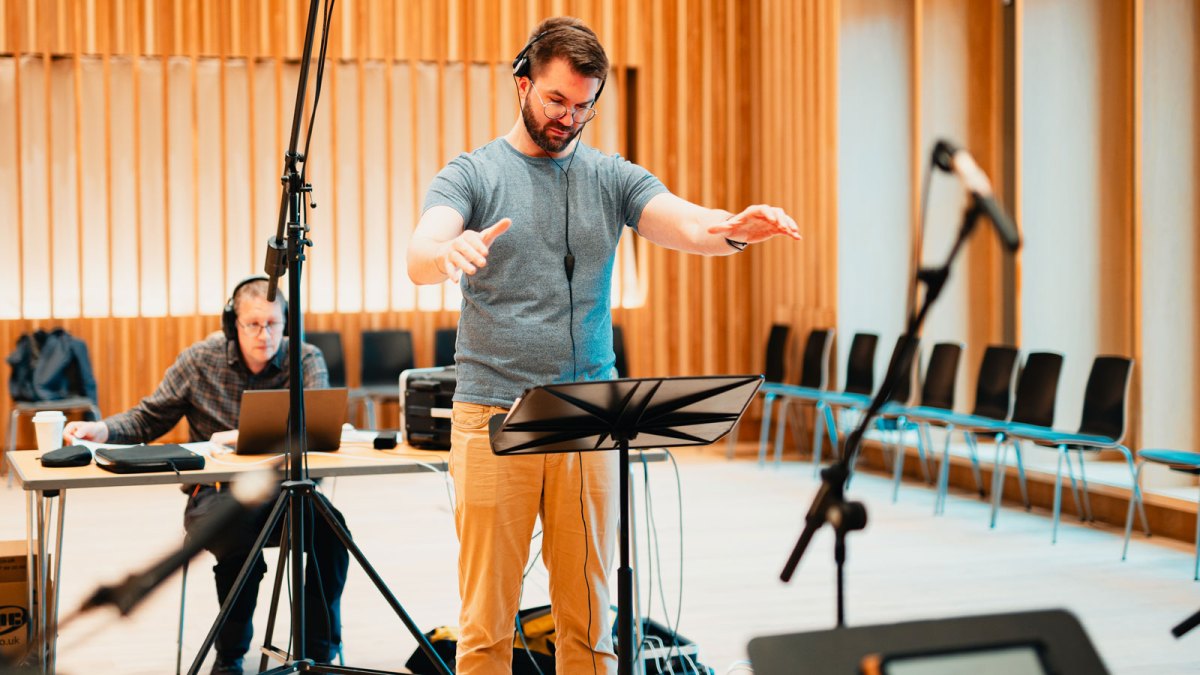
Composer, conductor and facilitator Michael Betteridge’s music sometimes moves like the ocean. In his reworking of Vaughan Williams’ one-act opera, “Riders to the Sea,” he stripped the orchestration to its emotional essence, replacing rich string textures with oboe, accordion, and bass clarinet. His new prologue was bold and theatrical as Bartley, silhouetted against a sea of projections, typed his opening lament on a laptop.
The space between music and theater is what attracted me to Betteridge’s work. But his art also thrives in the place where music meets community. He is a proudly queer composer, and themes of identity run through much of his work. This ranges from The Sunday Boys, the LGBTQ+ low voice choir based in Manchester that Betteridge founded in 2016, to a variety of socially engaged composition projects, including “Opera-tic,” a digital opera co-created with people living with Tourette’s syndrome, and “Market Songs,” a site-specific a cappella work performed with 300 singers in the streets of Salisbury.
Growing up, music was a hobby for Betteridge, who might have become an economist. Instead, he studied music at Manchester University, where he ran straight to the drama department to learn the theater skills necessary for his co-created work.
In our conversation, Betteridge talked about why co-creation rather than individual composition is at the heart of his practice, the difference between big “C” and little “C” composers, and whether the future of opera is as precarious as people think.
Unlimited access to our
