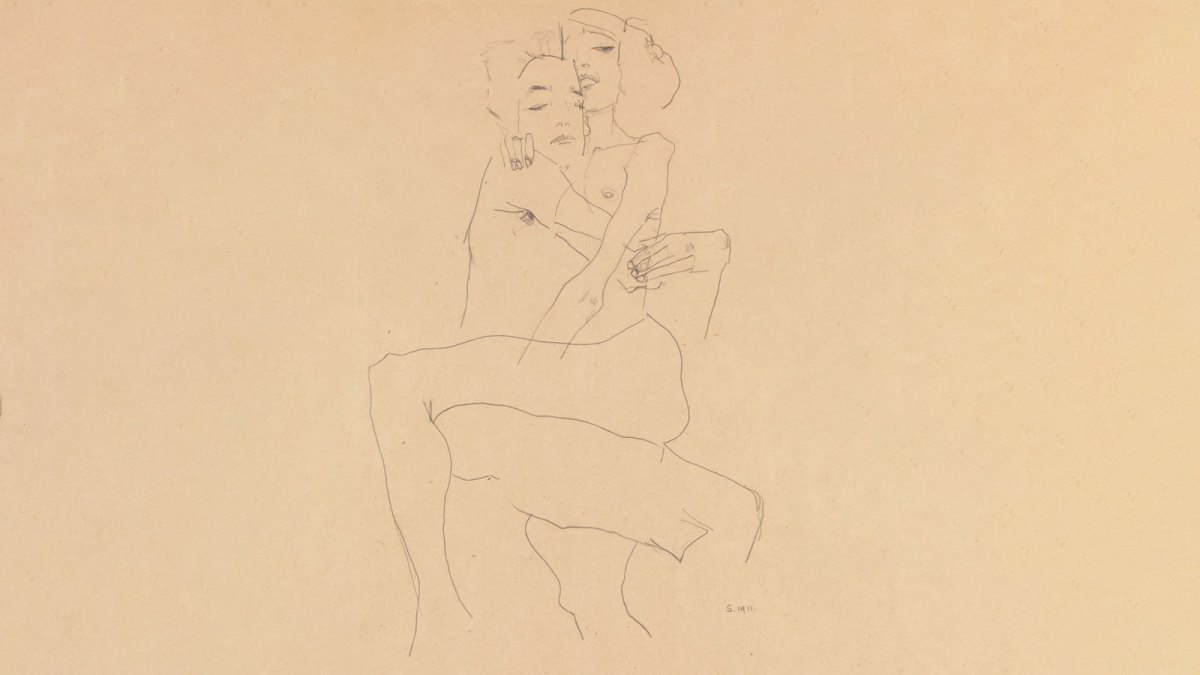
In his dazzling, fragmentary book A Lover’s Discourse, Roland Barthes wrote, “Language is a skin: I rub my language against the other. It is as if I had words instead of fingers, or fingers at the tip of my words.” When I first encountered this analogy in my early 20s, I felt somehow relieved. I didn’t love literary theory; however, I wanted, without completely knowing it, a theory that linked language and love, and a theorist who wrote with vigor and (ironically) directness about “the state of being in love.” Barthes was the thinker I’d been looking for. He pulled theory out of the ivory tower and made it an investment in the real: in my body and all the inexpressible—raw, stupid, and profound—experiences I was having around erotic and love relationships.
Barthes was born in Cherbourg, a port in northwest France, in 1915. After his father’s death in World War I, Barthes moved with his mother, Henriette, to Bayonne, a small town in the southwest. There he learned to play the piano (his Aunt Alice was a professional piano teacher), and developed a love of the music of Robert Schumann. After eight years in Bayonne, Henriette decided to move to Paris, where Barthes continued to study music: acclaimed baritone Charles Panzéra, to whom Gabriel Fauré dedicated “L’horizon chimerique,” became his teacher and taught him how to “work” a text. Perhaps not surprisingly, he fell in love with another of Panzéra’s students, Michel Delacroix, son of the famed philosopher and psychologist Henri Delacroix. In 1942, when Barthes was 27 years old, he and Michel both moved into a sanatorium to treat recurring episodes and complications of tuberculosis. Michel died in the sanatorium in 1943. Barthes remained there until 1946, claiming he was “happy” thanks to friendships and reading. He fell in love again in the sanatorium, with another TB sufferer, but this time his love was unrequited.
Given his personal history, it’s no wonder Barthes was so attuned to the body. One reason I love thinking about his conception of language as a skin is that it invites some formulation regarding music. If language is a skin, then music might be breath on the skin. According to one of his biographers, Tiphaine Samoyault, Barthes “did not have an intellectual relationship with music”; he viewed emotion, taste, and memory as the only “laws” of musical aesthetics. This mindset allowed him to love Schumann in the “purest” possible way. He said, “I hear [Schumann] as I love him… I love him with just that part of myself that is to myself unknown.” And: “Schumann’s music goes much farther than the ear; it goes into the body.”
A Lover’s Discourse is an atypical or peculiar text, though less so today than when it originally appeared; its publication helped usher in autofiction, but it began as a seminar Barthes taught at the Collège de France. Barthes set out to “essayify” his teaching, and the voice he proffered is and isn’t Roland Barthes. He created a speaker, for lack of a better term, to simulate how a lover thinks and talks about a beloved. This voice is magnificently intimate, but as Wayne Koestenbaum points out in his foreword to FSG’s recent edition of A Lover’s Discourse, the simulation “transcends any specific love relationship (platonic, pedagogic, familial, erotic) that Barthes underwent” and instead describes “the general experience of being in thrall to love’s categories.”
Significantly, Barthes shows that being in love is only ostensibly a private, singular experience—because one’s relationship to a “beloved” is always mediated by the social through the unconscious. As put by Andy Stafford, who, in my view, wrote the most enjoyable biography of Barthes, “A Lover’s Discourse showed how lovers play out a set of social constraints and limited freedoms via a language that is unknown (and unknowable, even) to scientific and humanistic knowledge.”
Although A Lover’s Discourse simulates unrequited love from a lover’s perspective, it can’t be adequately described as a book about unrequited love. It’s more a book about being in love. In an interview with Playboy from 1977, Barthes clarified this, explaining that “common sense tells us”—and this is where A Lover’s Discourse ends—“that there comes a time when one must uncouple ‘being in love’ from ‘loving.’” A person in love might feel “dominated, captivated, possessed” by a beloved, but the person in love is actually the one wielding “tyrannical power” in an effort to get what he or she wants. Barthes posited that the “ideal solution” to this was for the lover to inhabit “a state of the non-will-to-possess,” to “master desire in order not to master the other.” A kind of jiu-jitsu.
A Lover’s Discourse comprises 82 chapters, each headed by a figure or fragment of discourse that is born out of “amorous feeling” and signifies “the lover at work.” “I am engulfed, I succumb…,” for example, is the figure heading the first chapter. Barthes instituted order by alphabetizing them but noted that “no logic links the figures… the figures are non-syntagmatic, non-narrative; they are Erinyes; they stir, collide, subside, return, vanish with no more order than the flight of mosquitoes.”
For this playlist, I’ve attempted to illuminate ideas about love as well as how Barthes dramatized nuance—or “the Intractable”—in A Lover’s Discourse. Since Barthes rejected traditional narrative writing (the Aristotelian beginning, middle, and end), I’ve assiduously avoided any kind of progression. Instead, I’ve made my own attempt at out-of-a-hat “orderliness,” arranging figures, as best I could, to spell out LANGUAGE IS A SKIN.
I agree with Barthes’s final words in Playboy: “One should not let oneself be swayed by disparagements of the sentiment of love. One should affirm. One should dare. Dare to love…”
Off-Site Eden
A playlist for Roland Barthes’s “A Lover’s Discourse”