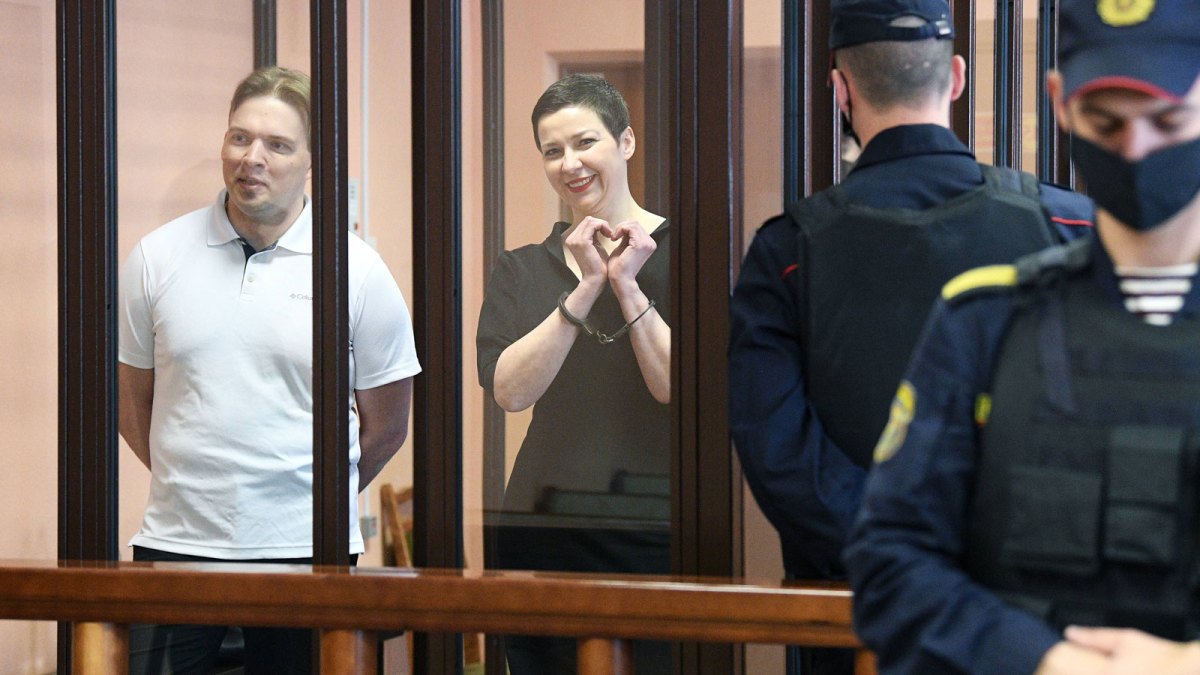
Nearly three years ago, Maria Kalesnikava, the Belarusian flutist, curator, politician, and icon of the resistance against the Lukaschenko regime, was sentenced to 11 years in prison for alleged “conspiracy with the intent of illegal power seizure” and “founding and leadership of an extremist organization,” in a case widely considered to be politically motivated. In 2020, Kalesnikava, along with Sviatlana Tsikhanouskaya and Veronika Tsepkalo, had challenged reigning dictator and Putin ally Lukaschenko in the presidential elections, then led the mass protests against him that followed. Kalesnikava was the only one of the three to remain in Belarus. In September 2020, she was kidnapped in Minsk by what is still known as the KGB there. She was threatened with death and nearly deported to Ukraine, a fate she avoided by tearing up her passport shortly before crossing the border. Since then, Kalesnikava has been detained as a political prisoner. In January 2022 she was transferred to Women’s Penal Colony No. 4 in the city of Homel.
Before her return to Belarus, Kalesnikava lived in Stuttgart for 12 years, where she earned master’s degrees in early and contemporary music, performed as a flutist with her trio vis-à-vis and other ensembles at German and international music festivals, and curated her own projects.
In May 2022, Kalesnikava, along with Tsikhanouskaya and Tsepkalo, received the Charlemagne Prize for work done in service of European unity. Then, Kalesnikava’s sister Tatsiana Khomich accepted the award on her behalf. I spoke to Khomich recently about the conditions of Kalesnikava’s detention and the potential for her to be included in a future prisoner swap.
Waiting Outside
An interview with Tatsiana Khomich on the detention of her sister, flutist and activist Maria Kalesnikava, in Belarusian solitary confinement