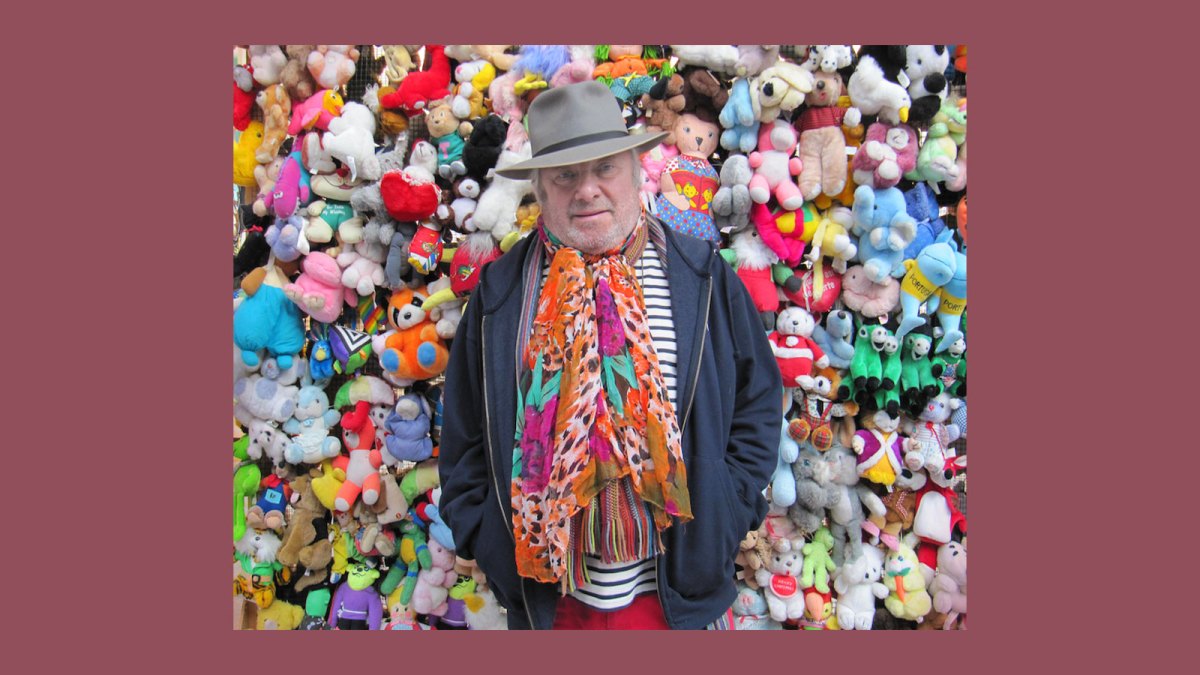
The first time I saw Charlemagne Palestine play was in a forest clearing on the grounds of a 17-century palace just outside Milan. It was a little after half-past eight in the evening in early July 2016 and the sun was just starting to set. The air was thick with weed smoke and mosquitoes. Wearing a brightly colored t-shirt and two peaked caps—one on top of the other—Palestine began his set ceremoniously, striking two brandy glasses together (one filled with water, the other with a diminishing quantity of brandy) to make a satisfying boink. The crickets all around began to chirrup excitedly. The clink of his beverages still resounding, he took his seat at a black Yamaha grand piano and started playing octaves in a brisk, loose tempo, surrounded on all sides by silk scarves and stuffed animals.
“Divinities, we call them,” the composer gently but firmly corrects me when I remind him of the occasion as we finally sit down to talk eight years later. I’ve caught him in the midst of packing for a trip to Art Basel Miami Beach, where he’ll be performing live and showing one of his Divinity Pianos, an instrument, much like the one I saw in Lombardy eight years ago, completely festooned with felt-stuffed icons of Babar the Elephant, Squirrel Nutkin, the Pink Panther and others. These divinities have been an important part of Charleworld for at least five decades now, when he first exhibited his work at New York’s Sonnabend Gallery.
By that time, he had already lived several lives: first as live conga player to Beat poets like Gregory Corso and Allen Ginsberg, then a carilloneur at St. Thomas episcopalian church on Fifth Avenue, where his bell-ringing attracted the attention of local musicians like Moondog, the Velvet Underground, and Tony Conrad (whose film “Coming Attractions” Palestine would later provide music for). He was a regular at Morton Subotnick’s Bleecker Street electronic music studio and developed the Spectral Continuum Drone Machine with Serge Tcherepnin. Early piano pieces from the mid-‘70s like “Strumming Music” and “Four Manifestations On Six Elements” earned him a place in the canon of minimalist music—though it’s a term he has consistently rejected, preferring to call himself a “maximalist” or any number of other terms plucked seemingly ad hoc from his wild-eyed, pony-tailed head.
We speak ahead of his forthcoming appearance at the London Contemporary Music Festival, where he will be charlefying the organ at Hackney Church in Lower Clapton. As he talks, his arms wave and gesture effusively. He is still wearing two different caps.
Liquid Continuum
An interview with Charlemagne Palestine