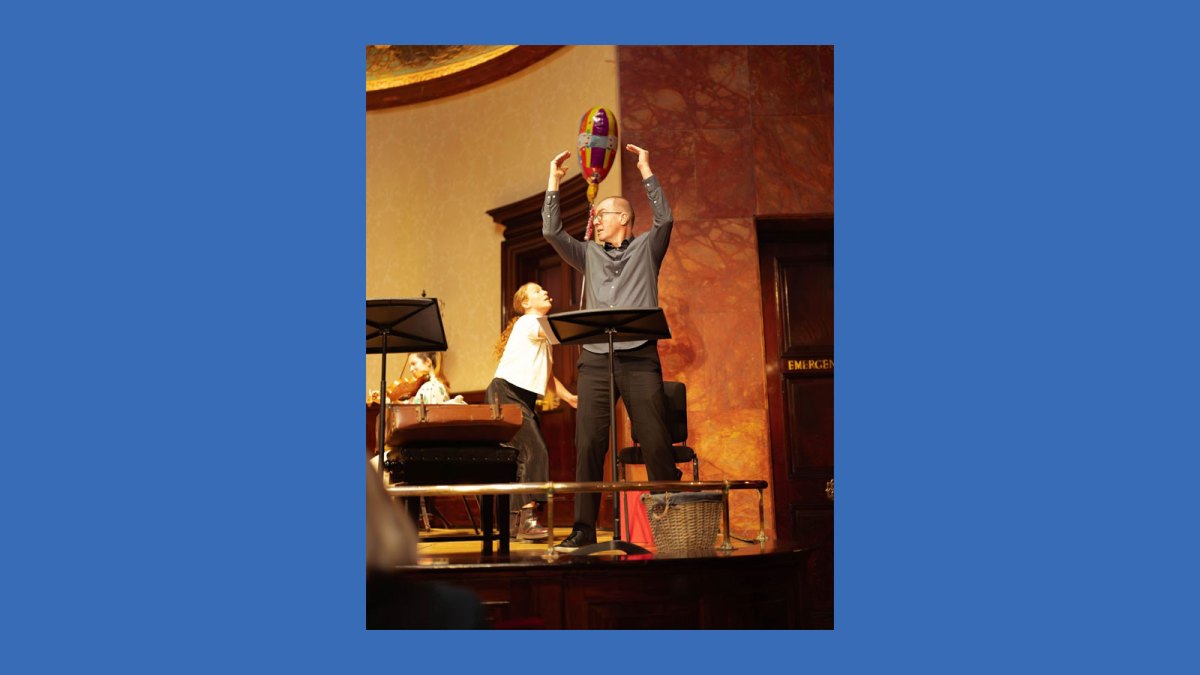
In 2022, I sang Benjamin Britten’s “War Requiem” at the Royal Albert Hall. During the performance a spotlit figure caught my eye, moving his hands dynamically and expressively with the musical flow, but who was neither a conductor, nor a singer, nor an instrumentalist. That figure was Paul Whittaker: a Deaf musician who uses British Sign Language to interpret musical works with major choirs and orchestras.
On the same day I interviewed Whittaker, the Los Angeles Philharmonic and Gustavo Dudamel performed Beethoven’s “Fidelio” at the Barbican in a staging co-created with Deaf West Theatre. Their artists signed the dialogue scenes intercutting the music, and doubled the singers’ roles; the Financial Times’s review described “a sense that another dimension had opened up, giving a deeper appreciation of Beethoven’s embrace of humanity in the opera.” It’s a sign that the classical music world is starting to address itself to the experiences and imaginations of the Deaf community. Deafness is part of musical history: Beethoven is the most obvious instance, but Vaughan Williams, Smetana and Fauré also experienced hearing loss.
Whittaker’s work has implications for hearing and d/Deaf audiences alike. The Deaf community has a complex and multifaceted relationship to music, as Whittaker explained to me. While there are of course many notable d/Deaf musicians, he noted that some Deaf people—often from the older generation—feel that the art form is not for them.
Such resistance has its roots in the historical exclusion of BSL. It was only officially recognized as a minority language in the UK in 2002, and given legal protections in 2022. Teaching BSL to Deaf children was banned until the 1970s. Its opponents insisted that “oralism”—speech in combination with lip reading—was the only way they could learn to communicate. Music, as a hearing-centric art form, was caught in this cultural crossfire. Currently, Music and the Deaf, founded by Whittaker in 1988, is the only UK charity exploring the enriching role music can play in the lives of people experiencing different levels of hearing loss.
Whittaker’s schedule is comparable to that of a top international soloist. When we spoke over Zoom, with his BSL interpreter Stephen, he had just returned from Malmö, where he’d been creating a version of Ravel’s “Ma mère l’Oye” accessible to the d/Deaf community, and then traveled to the Isle of Skye, via a Sunday concert at Wigmore Hall in London, for a series of workshops with the National Youth Choir, creating games and activities using the Kodály method. Next stop? Ludwigsburg, to work with the Mahler Chamber Orchestra.
The Reverse Conductor
An interview with Paul Whittaker, a Deaf musician who uses British Sign Language to interpret musical works